Showing posts with label Health tips. Show all posts

3 Ways To Get Pregnant Fast—Backed by Real, Hard Data

At a glance . . .

There are 6 fertile days per month

You are most fertile during the 1-2 days before ovulation

Tracking your cycle and knowing when you ovulate can help


How to get pregnant fast


When you know you’re ready for a baby, you probably want to know how to get pregnant fast. You might expect that getting pregnant will happen without your even trying. Go off contraception, have sex, and boom: pregnant!


Needless to say, it doesn’t always happen like that. Some couples conceive the first month, but for many couples, it takes much longer than that. This doesn’t necessarily mean there is anything wrong with you. The truth is, it’s just not as easy to get pregnant as you thought it was. For a young couple at the peak of their fertility with no underlying fertility issues, having well-timed sex during the fertile window, the chances of conceiving are about 25 percent per cycle. That means that even if you’re perfectly healthy and doing everything right, you’re never going to have better odds than one in four.


It’s important to go into this process knowing that you don’t have full control over how long it will take to get pregnant. That said, there are a few things you do have control over that can help increase the likelihood of getting pregnant quickly.


1. Get the timing right.


There are only six days per month when it’s possible for sex to result in pregnancy: the five days leading up to ovulation, and the day of ovulation itself (check out our fertility calendar). You can have sex every day or every other day during the fertile window—the chances of pregnancy are basically the same, so do what feels best for you and your partner.


If you don’t have time to have regular intercourse throughout the fertile window, try to hit at least the day before or two days before ovulation. Sex on those days offers the highest chances of conception.


Probability of Pregnancy
Days before ovulation

High O-1, O-2, O-3

Medium O, O-4
Low O-6, O-5, O+1


2. Know when you ovulate.


How do you get the timing right? You have to know when you ovulate, and be sure to have sex in the few days before that.


Don’t just download a period tracking app and trust what it tells you about your fertile days. The majority of fertility tracking apps have been shown to incorrectly estimate the fertile window based on clinical guidelines.


To complicate matters even more, only 30 percent of women have a fertile window that is in the time frame specified by clinical guidelines—that is, between cycle days 10 and 17. Some women start their fertile window earlier, and others start it later. What’s more, the fertile window may vary for the same woman from month to month.


There are much more accurate ways of finding your fertile window than relying on apps. Cervical mucus monitoring and ovulation tests can give you a heads up that your body is preparing to ovulate. Basal body temperature can confirm that ovulation occurred, but by that time, it’s too late to get pregnant that cycle. To find out the beginning of your fertile window and confirm ovulation in a single device, you can use the Ava bracelet.


3. Consider going off birth control ahead of time.


It’s possible to get pregnant as soon as you stop your birth control method. There is no medical reason that you need to take a break from hormones before trying to conceive.


But if you’re using a hormonal method of birth control, it may be worth going off it ahead of time and using an alternate form of protection until you’re ready to start trying. The reason is that when you are taking hormonal birth control such as the Pill, you don’t have a real menstrual cycle. With some forms of hormonal contraception, you still bleed, and with others, you do not. But even if you bleed, it’s not a real period. The synthetic hormones suppress your natural cycle.


Note that with progestin-only forms of hormonal birth control, such as the Mirena IUD and the mini-pill, you may still ovulate even if you’re not getting your period. But if you’re taking a combined oral birth control pill, or have a Nuvaring or Nexplanon, then you are likely not ovulating.


Since it’s so important to learn to track your natural cycle in order to increase your chances of conceiving quickly, going off contraception early can give you some time to reacquaint yourself with your cycle and learn how to track it. There’s a bit of a learning curve with most methods, so you may appreciate some time to practice before you feel the pressure to conceive.


Another reason to stop your contraceptive early is that it may take some time for your cycle to return to normal after stopping hormonal birth control. You are more likely to have anovulatory cycles, late ovulation, and short luteal phases in your first few cycles after stopping the Pill, all of which make it harder to get pregnant. You might even experience post-pill amenorrhea, when it takes a while for your cycle to return in the first place.
How to lose weight

Diet & Weight Management Feature Stories

10 Ways to Lose Weight Without Dieting

Simple changes to your lifestyle can help you lose weight and keep it off.

By Kathleen M. Zelman, MPH, RD, LD

FROM THE WEBMD ARCHIVES

Sure, you can lose weight quickly. There are plenty of fad diets that work to shed pounds rapidly -- while leaving you feeling hungry and deprived. But what good is losing weight only to regain it? To keep pounds off permanently, it's best to lose weight slowly. And many experts say you can do that without going on a "diet." Instead, the key is making simple tweaks to your lifestyle.

One pound of fat -- is equal to 3,500 calories. By shaving 500 calories a day through dietary and exercise modifications, you can lose about a pound a week. If you only need to maintain your current weight, shaving 100 calories a day is enough to avoid the extra 1-2 pounds most adults gain each year.

Adopt one or more of these simple, painless strategies to help lose weight without going on a "diet":

  1. Eat Breakfast Every Day. One habit that's common to many people who have lost weight and kept it off is eating breakfast every day. "Many people think skipping breakfast is a great way to cut calories, but they usually end up eating more throughout the day, says Elizabeth Ward, MS, RD, author of The Pocket Idiot's Guide to the New Food Pyramids. "Studies show people who eat breakfast have lower BMIs than breakfast-skippers and perform better, whether at school or in the boardroom." Try a bowl of whole-grain cereal topped with fruit and low-fat dairy for a quick and nutritious start to your day
  2. Close the Kitchen at Night. Establish a time when you will stop eating so you won't give in to the late-night munchies or mindless snacking while watching television. "Have a cup of tea, suck on a piece of hard candy or enjoy a small bowl of light ice cream or frozen yogurt if you want something sweet after dinner, but then brush your teeth so you will be less likely to eat or drink anything else," suggests Elaine Magee, MPH, RD, WebMD's "Recipe Doctor" and the author of Comfort Food Makeovers.
  3. Choose Liquid Calories Wisely. Sweetened drinks pile on the calories, but don't reduce hunger like solid foods do. Satisfy your thirst with water, sparkling water with citrus, skim or low-fat milk, or small portions of 100% fruit juice. Try a glass of nutritious and low-calorie vegetable juice to hold you over if you get hungry between meals. Be careful of alcohol calories, which add up quickly. If you tend to drink a glass or two of wine or a cocktail on most days, limiting alcohol to the weekends can be a huge calorie saver.
  4. Eat More Produce. Eating lots of low-calorie, high-volume fruits and vegetables crowds out other foods that are higher in fat and calories. Move the meat off the center of your plate and pile on the vegetables. Or try starting lunch or dinner with a vegetable salad or bowl of broth-based soup, suggests Barbara Rolls, PhD, author of The Volumetrics Eating Plan. The U.S. government's 2005 Dietary Guidelines suggest that adults get 7-13 cups of produce daily. Ward says that's not really so difficult: "Stock your kitchen with plenty of fruits and vegetables and at every meal and snack, include a few servings," she says. "Your diet will be enriched with vitamins, minerals, phytonutrients, fiber, and if you fill up on super-nutritious produce, you won't be reaching for the cookie jar."
  5. Go for the Grain. By substituting whole grains for refined grains like white bread, cakes, cookies, and pretzels, you add much-needed fiber and will fill up faster so you're more likely to eat a reasonable portion. Choose whole-wheat breads and pastas, brown rice, bran flakes, popcorn, and whole-rye crackers.
  6. Control Your Environments. Another simple strategy to help cut calories is to control your environment -- everything from stocking your kitchen with lots of healthy options to choosing the right restaurants. That means avoiding the temptation by staying away from all-you-can-eat restaurants. And when it comes to parties, "eat a healthy snack before so you won't be starving, and be selective when you fill your plate at the buffet," suggests Ward. Before going back for more food, wait at least 15 minutes and have a big glass of water.
  7. Trim Portions. If you did nothing else but reduce your portions by 10%-20%, you would lose weight. Most of the portions served both in restaurants and at home are bigger than you need. Pull out the measuring cups to get a handle on your usual portion sizes, and work on paring them down. Get instant portion control by using small bowls, plates, and cups, says Brian Wansink, PhD, author of Mindless Eating. You won't feel deprived because the food will look plentiful on dainty dishware.
  8. Add More Steps. Get yourself a pedometer and gradually add more steps until you reach 10,000 per day. Throughout the day, do whatever you can to be more active -- pace while you talk on the phone, take the dog out for an extra walk, and march in place during television commercials. Having a pedometer serves as a constant motivator and reminder.
  9. Have Protein at Every Meal and Snack. Adding a source of lean or low-fat protein to each meal and snack will help keep you feeling full longer so you're less likely to overeat. Try low-fat yogurt, small portion of nuts, peanut butter, eggs, beans, or lean meats. Experts also recommend eating small, frequent meals and snacks (every 3-4 hours), to keep your blood sugar levels steady and to avoid overindulging.
  10. Switch to Lighter Alternatives. Whenever you can, use the low-fat versions of salad dressings, mayonnaise, dairy products, and other products. "You can trim calories effortlessly if you use low-fat and lighter products, and if the product is mixed in with other ingredients, no one will ever notice," says Magee. More smart substitutions: Use salsa or hummus as a dip; spread sandwiches with mustard instead of mayo; eat plain roasted sweet potatoes instead of loaded white potatoes; use skim milk instead of cream in your coffee; hold the cheese on sandwiches; and use a little vinaigrette on your salad instead of piling on the creamy dressing.

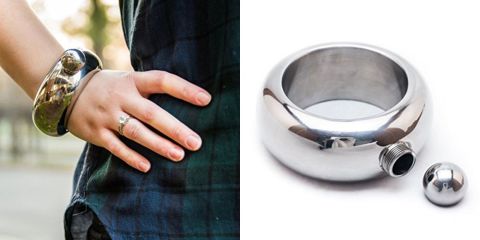
14 Genius Flasks That Look Like Ordinary, Everyday Items


How have you never thought of this?


Sometimes life calls for a drink when there are no drinks to be found. Enter: Brilliant flasks that look like books and bracelets, but are filled with your favorite booze.
Whether you're planning a trip to the beach or a picnic in the park, these brilliant disguises will keep you prepared at all times.